Pearson Edexcel · GCSE · Business
Course version: 1BS0 · Version from Sept 2017
Why businesses train and develop employees: ● the link between training,…
Full specification wording
Effective training and development: Why businesses train and develop employees: ● the link between training, motivation and retention ● retraining to use new technology.
Training and development are crucial investments that directly impact employee motivation and retention.
Checked against the Pearson Edexcel 1BS0 specification (opens in a new tab) on .
- Point 2 of 2
- 2 key terms
Study notes
From the checked teaching notes for this specification point.
The idea
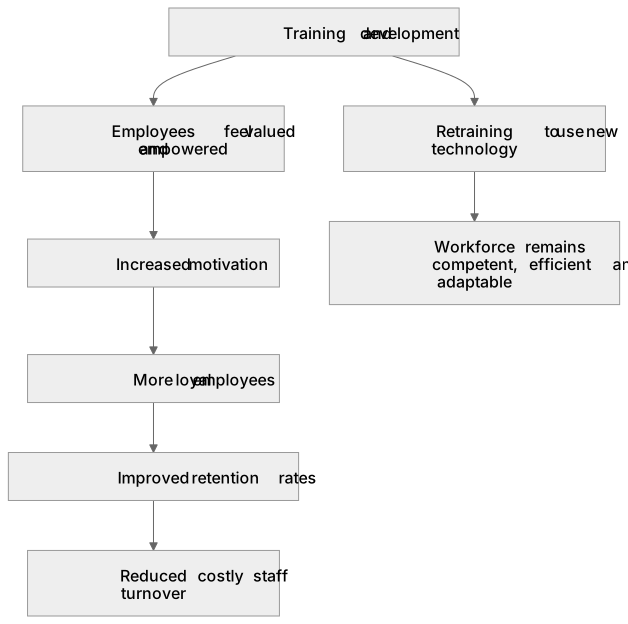
Training and development are crucial investments that directly impact employee motivation and retention. When a business provides training, employees feel valued and empowered. This increased motivation makes them more loyal, significantly improving retention rates and reducing costly staff turnover. For example, a retail company offering management training will likely keep ambitious staff who might otherwise leave for promotions elsewhere. Furthermore, businesses must actively retrain employees to use new technology, such as automated checkout systems or updated inventory software. This ensures the workforce remains competent, efficient, and adaptable to changing market demands, preventing the business from falling behind its competitors.
What earns the marks
- Explaining how training increases motivation by making employees feel valued and confident in their roles.
- Linking increased motivation from development opportunities to higher staff retention and lower turnover costs.
- Identifying the necessity of retraining staff when introducing new technology to maintain operational efficiency.
- Analysing the long-term financial benefits of training against the short-term costs of implementation.
Common mistakes and how to put them right
Confusing retention with recruitment.
Put it right: Retention refers to keeping existing staff, whereas recruitment is about hiring new employees.
Assuming training only benefits the employee.
Put it right: Emphasise that training directly benefits the business through higher productivity and lower turnover.
Stating that new technology automatically improves efficiency.
Put it right: Explain that new technology only improves efficiency if employees are adequately retrained to use it.
Exam tips
- Always link training back to a specific business benefit, such as reduced recruitment costs due to better retention.
- Use the context of the case study to identify what type of new technology might require employee retraining.
- When evaluating training, weigh the immediate financial costs against the long-term gains in motivation and productivity.
Try the lesson
The start of the Effective training and development: Why businesses train and develop employees: ● the link between training, motivation and retention ● retraining to use new technology. lesson, made from checked teaching notes for this specification point.
Have a go first
Which of the following is a primary reason why a business would choose to train and develop its employees?
Listen
Training and development are crucial investments that directly impact employee motivation and retention. When a business provides training, employees feel valued and empowered. This increased motivation makes them more loyal, significantly improving retention rates and reducing costly staff turnover. For example, a retail company offering management training will likely keep ambitious staff who might otherwise leave for promotions elsewhere. Furthermore, businesses must actively retrain employees to use new technology, such as automated checkout systems or updated inventory software. This ensures the workforce remains competent, efficient, and adaptable to changing market demands, preventing the business from falling behind its competitors. A strong answer earns marks for these points. Explaining how training increases motivation by making employees feel valued and confident in their roles. Linking increased motivation from development opportunities to higher staff retention and lower turnover costs. Identifying the necessity of retraining staff when introducing new technology to maintain operational efficiency. Analysing the long-term financial benefits of training against the short-term costs of implementation. A common slip: Confusing retention with recruitment. Instead, Retention refers to keeping existing staff, whereas recruitment is about hiring new employees. Exam tip: Always link training back to a specific business benefit, such as reduced recruitment costs due to better retention.
See it
Key words
Say what each word means before you turn the card.
Retention
Try answering aloud or in your head before turning the card.
Retraining
Try answering aloud or in your head before turning the card.
See every definition
- Retention
- Keeping existing staff, which improved motivation from training and development can significantly increase.
- Retraining
- Training employees to use new technology so the workforce remains competent, efficient and adaptable to changing market demands.
Label the diagram
Some boxes have lost their names. Pick the right name for each number.
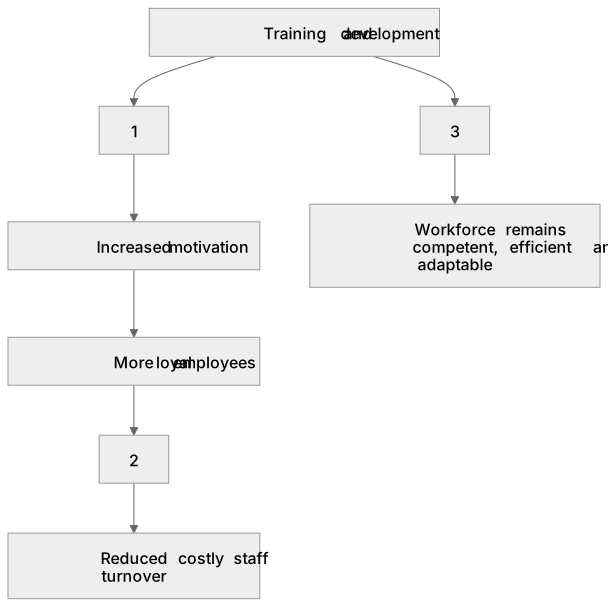
1Box 1
2Box 2
3Box 3
There is more to this lesson
The full lesson goes on to check your understanding and help you earn the marks. Create a free account to carry on, with your progress saved.
A week of Premium from your first lesson · Then the free plan continues · No card, no charge
Test your understanding of Effective training and development: Why businesses train and develop employees: ● the link between training, motivation and retention ● retraining to use new technology.
Active recall beats re-reading. Take an instant quiz now to test what you’ve learned and lock it into long-term memory.
A week of Premium from your first lesson · Then the free plan continues · No card, no charge